

VR Racing Simulators: The Future of Virtual Motorsports
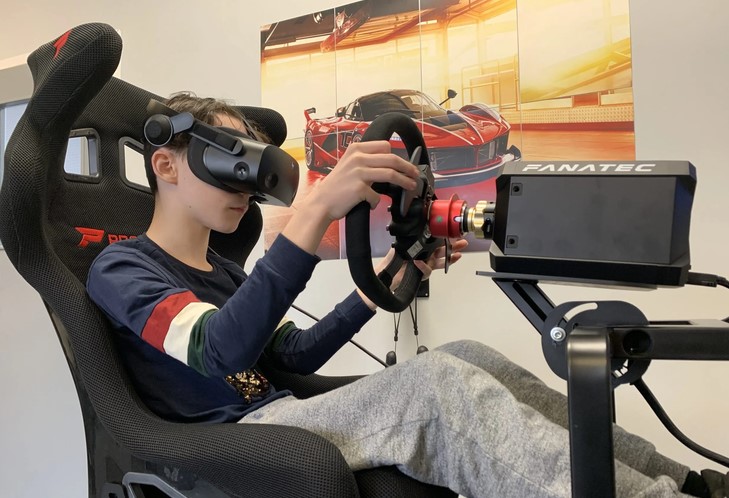
Source:https://i0.wp.com
You are screaming down the straightaway at Spa-Francorchamps at 180 mph. Your hands grip the alcantara wheel, your heart pounds against your ribs, and as you hit the braking zone for Eau Rouge, you instinctively look deep into the apex of the turn—not at a flat screen, but into a fully three-dimensional world.
Ten years ago, when I set up my first triple-monitor rig, I thought I had reached the pinnacle of virtual motorsports. But the moment I put on a modern head-mounted display and sat inside a cockpit powered by VR racing simulators, everything changed.
The flat screen suddenly felt like looking at a race track through a living room window, while VR placed me right inside the driver’s seat. If you have ever wondered whether making the leap into virtual reality sim racing is worth it, this deep-dive guide will walk you through everything you need to know.
Why VR Racing Simulators Are Replacing Traditional Screen Rigs
Traditional sim racing relies on flat monitors or triple-screen configurations. While triple monitors give you peripheral vision, they lack true depth perception.
In real-world driving, your brain constantly calculates distance, speed, and braking points using binocular vision. VR racing simulators trick your brain into perceiving genuine spatial depth, allowing you to judge apexes and braking zones with natural human intuition rather than muscle memory alone.
[Traditional Monitors] -> Flat Image + Limited Depth Perception -> Manual Calculation
[VR Racing Rig]       -> Stereoscopic 3D + Spatial Depth     -> Natural Intuition
Here is why immersion in virtual reality transforms the entire driving dynamic:
-
Stereoscopic 3D Vision: By rendering two distinct images—one for each eye—VR creates real spatial depth. You can instantly tell if a car is two inches or two feet away from your side bumper.
-
Natural Head Tracking: Instead of mapping a button on your wheel to look left or right, you simply turn your head to check your side mirrors or scan blind spots during aggressive overtaking.
-
Space-Saving Efficiency: A full triple-monitor rig demands a dedicated room or massive floor footprint. A VR setup offers an infinite 360-degree field of view (FOV) while taking up only the physical footprint of your racing seat and wheel stand.
Industry Insight: Think of a traditional screen setup as watching a roller coaster video on a high-definition TV. VR, on the other hand, is like physically sitting in the front cart of the roller coaster itself. The visual data is no longer something you observe; it becomes an environment you occupy.
The Tech Under the Hood: Key Hardware Requirements
To enjoy seamless VR sim racing without motion discomfort, your system must maintain high frame rates continuously. Unlike standard gaming where a dropped frame causes a minor visual stutter, dropping frames in VR can trigger motion sickness.
| Hardware Component | Recommended Entry-Level | High-End Performance | Impact on VR Experience |
| Graphics Processing Unit (GPU) | RTX 3060 Ti / RX 6700 XT | RTX 4080 / RTX 4090 | Drives high resolution and prevents frame drops |
| Central Processing Unit (CPU) | Intel i5-13600K / Ryzen 7600X | Ryzen 7 7800X3D / i9-14900K | Manages physics calculations and complex telemetry |
| VR Headset | Meta Quest 3 / Pico 4 | Valve Index / Pimax Crystal | Determines visual clarity, FOV, and screen-door effect |
| Direct Drive Wheel Base | 5 Nm – 8 Nm Force Feedback | 12 Nm – 20+ Nm Force Feedback | Translates tire grip and road surface telemetry |
1. High Resolution and Refresh Rates
Look for headsets with high per-eye pixel counts to eliminate the screen-door effect (seeing the space between individual pixels). A refresh rate of 90Hz to 120Hz is essential to keep the visual feedback smooth and responsive.
2. Direct Drive Force Feedback
To complement the immersive visuals, pair your headset with a Direct Drive (DD) wheel base. Direct Drive motors connect the steering wheel directly to the motor shaft, transferring micro-vibrations, loss of traction, and suspension changes instantly to your hands.
3. Load Cell Pedals
Gauging braking pressure using distance (like a budget pedal spring) breaks immersion. Load cell pedals measure actual force applied—just like a real race car’s hydraulic brake system—allowing your muscle memory to control braking pressure far more accurately in VR.
Overcoming Motion Sickness in VR Sim Racing
The most common hurdle for beginners transitioning to VR racing simulators is vestibular disorientation. This happens when your eyes tell your brain you are moving at 150 mph, but your inner ear senses that you are sitting stationary in a chair.
If you feel nauseous during your first few laps, do not panic. Overcoming this is a normal adaptation process often called getting your “VR legs.”
-
Start with Slower Cars: Begin your journey in Mazda MX-5 Cup cars or slower road vehicles before jumping straight into a twitchy Formula 1 car or GT3 racer.
-
Keep Sessions Short: The moment you feel warmth, dizziness, or sweatiness, take the headset off immediately. Pushing through nausea reinforces bad brain associations with the headset.
-
Position a Desk Fan: Placing a small fan in front of your rig blowing fresh air onto your face grounds your sense of orientation and cooling comfort.
-
Enable Horizon Locking: Most modern sim titles (like iRacing or Assetto Corsa) offer a setting that locks the virtual horizon to your gaze, reducing sudden pitch and roll movements.
Pro Tip vs. Hidden Pitfall
💡 Pro Tip: Optimize FOV & IPD Adjustments
Physical comfort directly impacts performance. Always measure your Interpupillary Distance (IPD)—the physical distance between the centers of your eyes—and adjust your headset’s physical slider accordingly. Getting your IPD right aligns the headset’s sweet spot, eliminating eye strain and blurriness during long endurance stints.
⚠️ Hidden Pitfall: Overheating & Thermal Throttling
VR headsets generate significant heat, and your PC will run at full capacity. Never place your VR rig in an unventilated corner. Thermal throttling will cause sudden frame drops mid-race, breaking your focus and triggering immediate visual disorientation.
The Final Lap: Stepping Into the Cockpit
The evolution of VR racing simulators has permanently altered how we experience virtual motorsports. By combining high-resolution headsets, direct drive force feedback, and accurate physics engines, virtual racing has bridged the gap between gaming and authentic motorsport training.
Whether you are aiming to shave off tenths of a second on your favorite track or simply looking to feel the adrenaline of wheel-to-wheel battles, virtual reality offers an unparalleled sense of presence.
Are you planning to build a VR racing rig, or are you still loyal to multi-monitor setups? What track are you dying to tackle first in VR? Let’s talk racing in the comments below!